China-Eurasia Expo expands international reach with debut of four national pavilions
The 9th China-Eurasia Expo officially opened on June 25, 2026. As a core platform for China's westward opening, this year's expo has seen a comprehensive upgrade in its international participation, openness and influence.
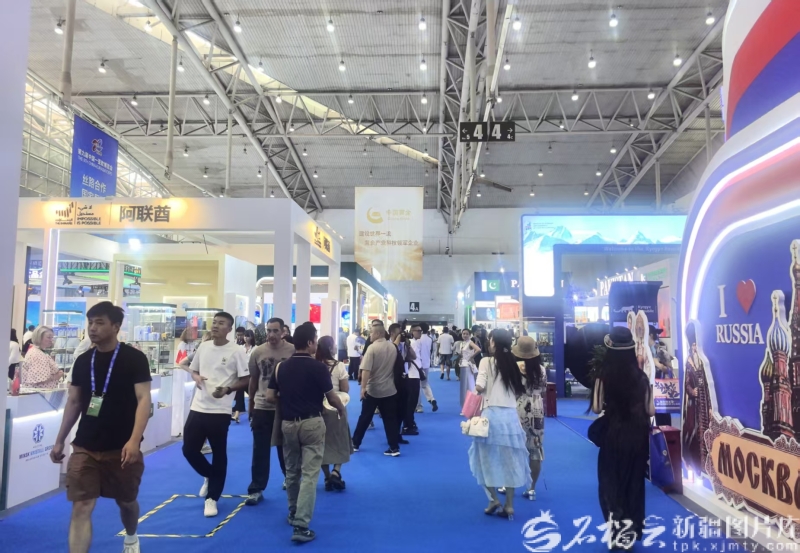
A total of 49 countries, regions and international organizations are taking part, with 27 countries and regions setting up exhibition pavilions. Notably, the United Arab Emirates, the Republic of Korea, Russia and Thailand are making their debut with independent national pavilions.
At the Silk Road Cooperation Zone, specialty products from various countries are on display, offering visitors a glimpse of diverse cultures.
Kazakhstan, one of the guest countries of honor, has brought more than 30 companies to the expo. A representative from Kazakhstan's Ministry of Trade and Integration noted that trade between Kazakhstan and China’s Xinjiang has grown steadily year by year, and the country has benefited significantly from its previous participations. The official expressed hope that the expo would help more Chinese companies learn about Kazakh products, deepen economic ties, and attract more Chinese investment to Kazakhstan. A dedicated Kazakhstan sourcing event will also be held during the expo to facilitate targeted cooperation.
The four new national pavilions have injected fresh energy into the expo.
The Thailand pavilion is filled with the rich aroma of tropical fruits. Golden mangoes, plump mangosteens and other high-quality fresh fruits are on display, along with a variety of Thai fruit snacks and processed products.
Chanwit Ruangchaithaweesuk, commercial consul at the Commercial Office of the Royal Thai Consulate General in Kunming, said that with the continuous improvement of cross-border transport and logistics, Thai goods can now reach Xinjiang in just one to two weeks. He noted that logistics efficiency has greatly improved and trade channels have become smoother. He also said that Xinjiang, with its unique geographical advantages and extensive cross-border logistics network, serves as a key commercial hub connecting Asia and Europe, helping Thai products reach markets in Central Asia, Europe and beyond.
Nearby, the Republic of Korea pavilion drew crowds of young visitors to its beauty and cosmetics display. A representative of a Korean cosmetics company said the firm has been active in the Chinese market for eight years and that this was its first foray into Xinjiang, with more than ten products on display. The representative added that as an important gateway for China's westward opening, Xinjiang holds huge market potential, and expressed hope that the expo would serve as a platform to build a bridge for economic and trade cooperation between the Republic of Korea and western China, as well as Central Asian countries.
The Russia pavilion offered a mix of accordion music and the hearty aroma of freshly baked rye bread, while the UAE pavilion attracted visitors with its desert charm and dazzling jewelry.
"This is my third time attending the China-Eurasia Expo. This year, I can clearly feel a higher level of internationalization. For those of us in cross-border trade, that means more opportunities," said Zhu Xiaolong, a businessman from east China's Zhejiang Province.
Behind the debut of these four national pavilions lies the confidence of companies from around the world in the Chinese market and a shared aspiration to deepen economic and trade cooperation across Eurasia.